Across organizations, leaders describe a remarkably similar experience.
They care deeply about the people their technology supports, and they understand that experience matters.
Yet when decisions need to be made—when priorities must be set and investment justified—impact is often inferred rather than seen.
This is not a failure of intent or leadership. It is a consequence of scale.
Why impact is often inferred, not seen
As organizations grow, lived IT experience fragments across roles, regions, workflows, and moments that sit outside formal design. Leaders compensate with proxies: ticket volumes, satisfaction averages, benchmarks, periodic conversations. Each abstraction is reasonable in isolation. Together, they create distance. Over time, experience becomes something to interpret rather than something to recognize.
Several leaders described reaching a point where they could no longer tell whether they were focusing on the right things.
When prioritization drifts without shared reality
Bridget Collins, CIO at Cerence, described how easily prioritization can drift when experience is not clearly visible:
“I was really struggling with understanding how I was doing from an end-user services perspective. Without that data, I may have actually prioritized the wrong thing.”
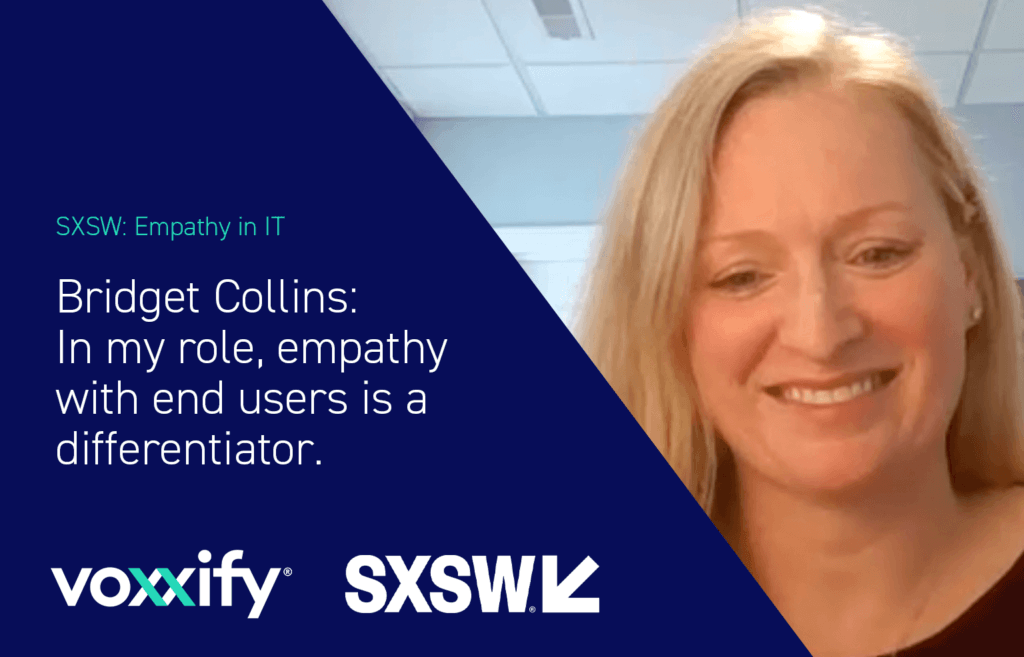
Watch the full interview with Bridget Collins ->
Looking back, she noted that some areas that felt chaotic were stable, while others that appeared under control were not. Without a shared view of experience, effort risked being misdirected.
Why the loudest signals distort focus
Others pointed to a related pattern: the loudest signals are rarely the most important ones.
Matt Roberts of Dell Technologies described how traditional indicators distort focus:
“Listening to the people that scream the loudest and measuring success by closing support incidents—those are ways of the past.”

Watch the full interview with Matt Roberts ->
Support activity shows where friction surfaces. It does not reliably indicate where impact concentrates. Focusing on the lowest scores or the most visible complaints can feel decisive, yet it often draws attention away from the issues that shape overall experience most strongly.
What leading organizations do differently
Chris Murphy at BCG described how leading organizations address this—not by guessing, but by making experience visible enough to guide action:
“The organizations that perform the best don’t leave it to chance. They measure satisfaction so they understand how IT is perceived, and they let employees help prioritize what matters most.”

Watch the full interview with Chris Murphy ->
At enterprise scale, this distinction matters. Without a clear, shared view of experience, feedback becomes harder to contextualize and harder to act on. What begins as a measurement challenge quietly becomes a decision challenge.
When empathy becomes a stand-in for clarity
It is in this space that leaders often reach for the language of empathy. Not because they lack care, but because they lack clarity. “Empathy” becomes a way of naming the difficulty of understanding how technology actually lands for different people, in different contexts, over time.
What changes when experience is visible
When lived experience becomes visible and shared, something shifts. Assumptions soften. Priorities reorder without debate. Decisions feel proportionate rather than forced. Leaders describe the relief of recognizing reality clearly enough to act with confidence, rather than relying on instinct or noise.
This is where clarity begins.
Leaders do not need to care more.
They need to see more clearly.
When impact has to be inferred, decisions feel heavy.
When experience is visible, decisions feel lighter—and momentum follows.